Written by Nicolas Francis
League of Storytellers
This past February 24th, SUNY Geneseo held its 8th annual Diversity Summit. The Annual Diversity Summit is a full-day event dedicated to dialogue, reflection, and action. It consists of many individual sessions centered on diversity and belonging, hosted by members of the campus community and guests. Culminating in a featured event and the Keystone Speech. This year’s theme was Courage, described by Geneseo as “the courage to be vulnerable, to be authentic, to show up, to make movement, to change, to persist, and to grow.”
With classes canceled for the day, students, faculty, and staff filled the Union and Bailey Hall from early morning to late afternoon, participating in a myriad of sessions designed to foster meaningful engagement across identities and experiences.
The day began with “fan favorite” Summit Sunrise Yoga. This was hosted in the Multicultural Center by Geneseo’s own Dr. Lee Pierce, professor of rhetoric and communication. It served as an invigorating start to the Diversity Summit. Also, during the start of the day and throughout the entirety of the morning sessions, Baily Hall was host to both Creative Energizers and Morning Warm-Ups. The two Morning Warmups were the Diversity Summit Information Table. Where willing participants could stop by to learn more about the summit schedule, grab a name tag, a cup of coffee, or even just say Hi. The second one was Doggy Therapy. Here, participants could get love and snuggles from Genoseo’s favorite therapy dogs, Myko and friends. Running at the same time were the Creative Energizers. These were the Cultivating Community Room of Play and the Community Creative Project. The Cultivating Community Room of Play was a room where you could connect with other participants by playing board and card games. This year’s annual Community Creative Project encouraged Diversity Summit attendees to
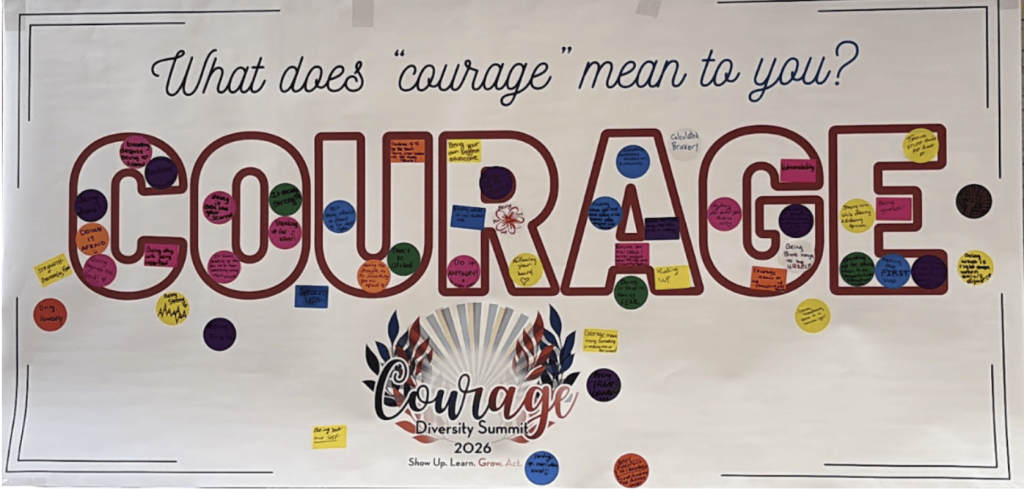
reflect on what Courage means to them and place those meanings on a large board that said “Courage.” These special Warm-Ups and Energizers ran at the same time as the many morning sessions, some of which will be spotlighted here.
Spotlight Session #1: Global Competency Through Diverse Children’s Storybooks
The first of these spotlighted sessions that will be talked about was the session called “Global Competency Through Diverse Children’s Storybooks,” hosted by Dr. Peter Kalenda and Dr. Kathleen Olmstead. Dr. Kalenda is an Assistant Professor at SUNY Geneseo who specializes in offering courses in inquiry-based science education methods, and Dr. Olmstead is an Assistant Professor at SUNY Brockport who specializes in Children’s literature, Family literacy, and Early childhood education. And they recognized a challenge in the teacher candidates they were teaching, a lack of Global Competency. As Dr. Olmstead put it, “We both teach at rural, suburban schools and…many of our teacher candidates’ cultures and linguistic diversity does not match that of their future students.” She goes on to say that she and Dr. Kalenda wanted to work together to “kind of increase cultural representation and inclusivity in…classrooms” and that they wanted to “focus on improving global competency for…teachers.” Dr. Kalenda then explains what global competency means. In his words, he defines it as “The skills and dispositions that you would need as an individual in order to understand and take action on some sort of global issue.” So how did they focus on doing this? They rethought Dr. Kalenda’s STEM methods classes and Dr. Olmstead’s literacy methods classes by using global, diverse children’s books. Some of these books include Tu Youyou’s Discovery: Finding a Cure for Malaria by Songju Ma Daemicke from China, The Story of Architect Zaha Hadid by Victoria Tentler-Krylov from Iraq, Flipflopi: How a Boat Made from Flip-Flops Is Helping to Save the Ocean by Linda Ravin Lodding and Dipesh Pabari from Kenya, and The Tree of Hope: The Miraculous Rescue of Puerto Rico’s Beloved Banyan by Anna Orenstein-Cardona from Puerto Rico. Through their research, Dr. Kalenda and Dr. Olmstead collected both qualitative and quantitative data from 61 teacher candidates from the two kinds of classes and found that after the introduction of the books, there was a drastic shift in global competency. Through the quantitative data, an uptick in the number of teacher candidates who self-identified along certain markers for global competency was found. And on the qualitative front, a clear shift in the pedagogy of the teacher candidates towards more inclusive language and actions was found. This session ended with the opportunity for the participants to choose one of their own diverse storybooks and discuss it with other participants.
Spotlight Session #2: Disability as Identity
The second session spotlighted was called “Disability as Identity,” and it focused on how a persons disabilities defined them and how they make up someone’s identity. It started with the medical vs social model of observation and asked the participants to consider how we view a problem. The primary focus of this idea is that we as a society need to switch our mindsets from the medical model to the social model. The medical model sees the issue as the physical disability, a problem to be solved. Yet the social model sees that the social boundaries that make living with the disability harder as the issue, an obstacle to overcome. Disability is a social construct, an identity, not a medical problem; changing the way we view this issue will drastically help all. Next, the presentation delved into how we can change our everyday language to stop microaggressions and start to see the social issues surrounding disability. Some examples given were things the average person might say daily, but could cause serious damage to people who are disabled. Things like “that’s nuts,” “you’re crazy,” or “that’s so OCD.” Next, the program explained the differences between “D” and “d” in Deaf culture. The difference between someone who is capital D Deaf, or someone who identifies within the Deaf and Signing community, and someone who is diagnosed with lowercase d deafness, a medical condition. It’s more of how we see the problem, social vs medical. It ended with how we can help. It explained that the most important part is staying active in communication. The language around these people and their own personal disabilities, and how they identify, is ever evolving, and the best thing anyone can do is be present and active in learning about how they can help and what they can do.
Spotlight Session #3: Ubuntu Circle: Professional Development Series for Black and Brown Students
This session was called “Ubuntu Circle: Professional Development Series for Black and Brown Students,” and it lasted for 60 minutes. The primary focus of this session was on how to best help black and brown students in their lives, both at SUNY Geneseo and post-grad. It calls upon this idea of an Ubuntu Circle. But what is that? During the session, participants learned of a South African philosophy of community, supporting each other’s growth and well-being, and making sure no one is left behind. This philosophy is called Ubuntu. The word Ubuntu literally translates to humanity in some Bantu languages, such as in Ndebele, Xhosa, and Zulu. It is the idea of “I am because we are.” The presenters of this session hope to bring this same philosophy of community to SUNY Geneseo in the form of multiple professional development series. They aim to provide resources to all students in the form of internships, references, and opportunities, and due to Geneseo’s status as a predominantly white institution, diversifying the available opportunities. They are also currently advocating and forming relationships to vouch for students’ integrity to get into grad school and jobs. The goal is to have multiple roundtable discussions and panels to help underrepresented students prepare for their time post-grad.
Putting students in the best mindset and support to succeed regardless of experience or qualifications. The session ended off with a powerful quote that both draws on the past and looks to the future. “It takes a village… to help students transition through this stage of their life.”
Spotlight Session #4: Who Is College ACTUALLY Designed For?
The last spotlighted session was called “Who Is College ACTUALLY Designed For?” and was presented by Geneseo student Uzoma Ikeanusi. This session was actually an interactive learning lab. Complimenting the central idea of how college is built for people who already know things was a specific activity. Ikeanusi stated that most colleges think that “academic struggle is a personal shortcoming rather than a design issue. She introduced concepts such as cognitive load therapy, working memory, and intrinsic loads. Through these explanations, participants learned how colleges act towards students who know things coming in and those who simply don’t. The next phase of the learning lab was the introduction of two hypothetical characters. Chima and Obioma. Chima went to South Shore High School in Brooklyn, and Obioma went to Brighton High School in Rochester. “Both of them have a very strong work ethic,” she explained, but “their college prep in high school looked very different.” Chima’s college prep was an increased workload, while Obioma received college prep in the form of exposure to college-level concepts. The college treated both students the same, and Obioma excelled while Chima fell behind. Rather than recognize the design flaw in the system, the average college would blame Chima themselves. The final part of this session was the interactive lab. There was a statement given to the participants that included a lot of high-level academic vocabulary. The participants were then instructed to decipher the meaning of the statement. To simulate prior knowledge, half the participants were given a “hint,” definitions of the large academic words, while the other half received nothing. The half with the hint excelled in the challenge, while the other half was also able to complete it; there was significant stress. This interactive lab perfectly shows that college is designed for people with prior knowledge and not for the average student.
Featured Event
This year’s featured event was the Hair Monologues, presented by Geneseo students Casey Dapshi and Archer Maduro. This event focused on how individual people’s hair influenced their identity. These stories require courage and vulnerability, and they serve as an invitation to audience members to bravely share and consider the power in their own stories. As the program stated, whether you “cut, grow, pick, braid, dye, shave, or lost” your hair is your own and its aprt of your identity. Maduro started this event three years ago with a piece about their own hair, and it’s grown every year from there with more people and more stories. “For many people, there is so much more than just hair. It’s something…more…intimate, empowering, something sacred to ourselves and who we are.”
Keynote Address
The day ended with a keynote address on Aspirational Masculinity by Don McPherson. If you would like to hear more about this speech and the League of Storytellers’ exclusive interview with Don McPherson himself, please read our other article on https://storytellers.geneseo.sunycreate.cloud/. That article is all about the interview, the keynote address, and also his general philosophy. Make sure to follow us on Instagram @storytellerleague and be on the lookout for more exclusive interviews and stories on our website https://storytellers.geneseo.sunycreate.cloud/.
0 Comments